Lifting Columns for vacuum conveyors
Lifting columns, hoists or column lifts allow a vacuum conveyor to be quickly docked and undocked from a machine or container. This makes cleaning and maintenance easier and enables faster product changes. Additionally, the machine and the vacuum conveyor are mechanically decoupled from each other. This makes handling the vacuum conveyor simple, safe and ergonomic for personnel. With a mobile or wheeled lifting column, the vacuum conveyor can be used on different process lines.
Lifting columns have numerous applications. The appropriate designs also meet the high cleaning and hygiene requirements of the pharmaceutical industry, for example. They can also be operated in production areas with explosive dust.
Stationary and mobile lifting columns
In general, there are two types of lifting column: stationary and mobile. The most suitable design depends on the task at hand and the spatial conditions.
Stationary lifting columns
A stationary lifting column, hoist or column lift is installed permanently on the floor in the place of use. For tall columns and heavy loads on the jib, it can be fastened to the ceiling for additional support.
In addition to vertical lifting, the column can be fitted with a swivel mechanism. Depending on the design, either the entire column rotates around its vertical axis, or the boom is attached to the column via a joint.
Stationary lifting columns require only a small footprint. They can achieve large lifting heights and long reach. They are very simple to operate, and precise positioning of the vacuum conveyor at the delivery point is always guaranteed.
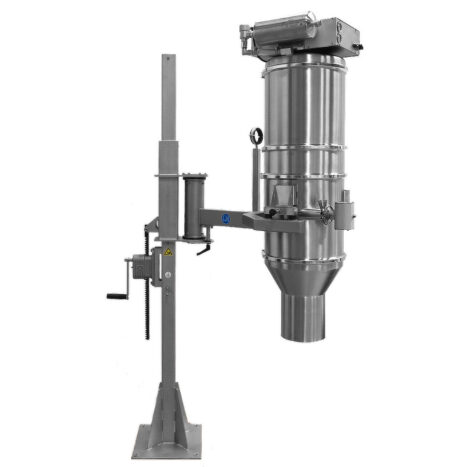
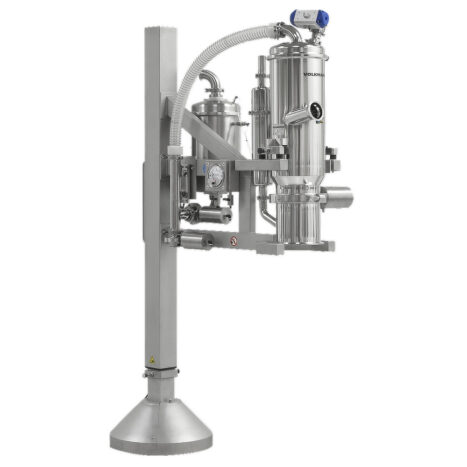
A lifting column with a mechanical drive and a swivelling arm. A VS vacuum conveyor with a Multijector pump is mounted on the fork.
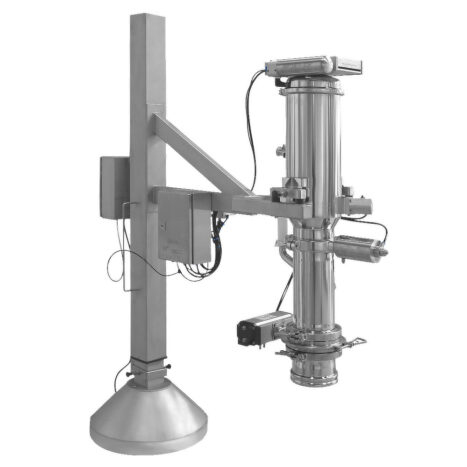
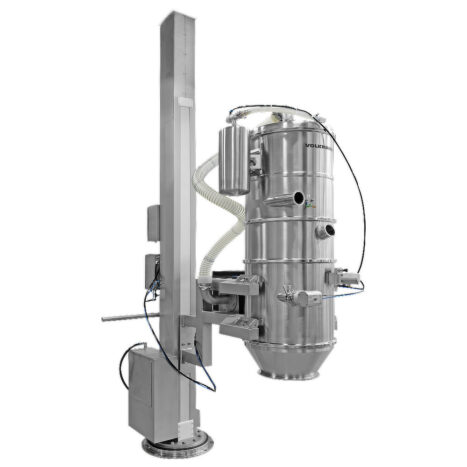
This lifting column features pneumatic height adjustment and swivelling around the vertical axis. A PPC vacuum conveyor is installed in the lifting fork. Material is discharged via a double-flap sluice.
Mobile lifting columns
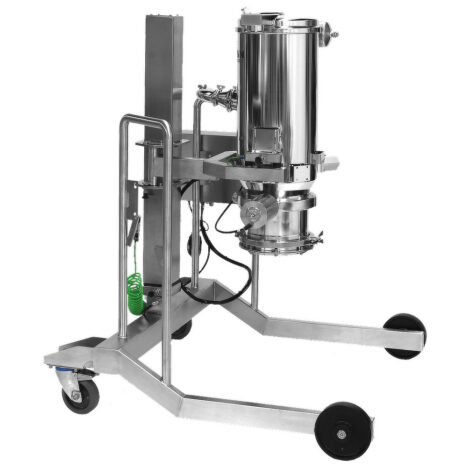
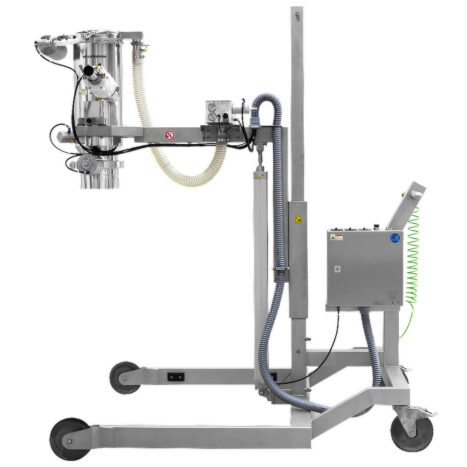
This is a mobile lifting column with pneumatic height adjustment. The boom can swivel to the right via a joint. Vacuum conveyor from the PPC series with a disc valve at the product discharge point.
The image shows the conveyor in its lowest (transport) position.
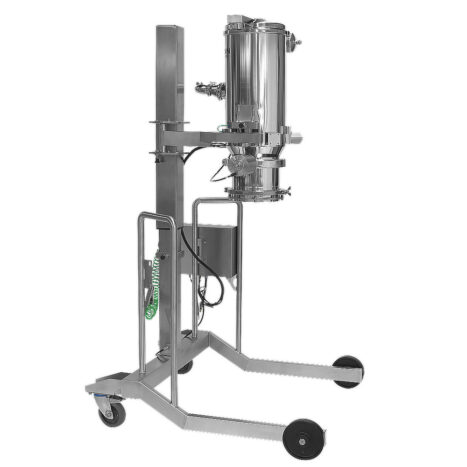
This is a mobile lifting column with pneumatic height adjustment. The boom can swivel to the right via a joint. Vacuum conveyor from the PPC series with a disc valve at the product discharge point.
The image shows the conveyor in its highest position.
A mobile lifting column with pneumatic height adjustment. PPC series vacuum conveyor featuring a valve at the product inlet and a disc valve at the product outlet. The Multijector vacuum pump is mounted separately from the vacuum conveyor on the boom.
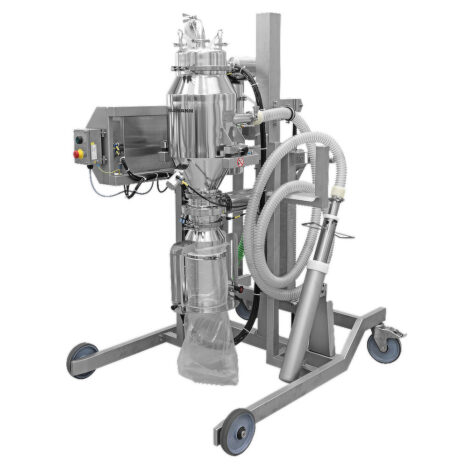
Mobile lifting column with mechanical height adjustment and PPC series Vacuum conveyor. Product feed via a suction lance. There is a disc valve connected to the product outlet with a holder for a continuous liner underneath. The control system and vacuum pump are located on the side.
A mobile lifting column enables the vacuum conveyor to be used at multiple delivery points, such as for filling several stationary mixers. Together with the vacuum conveyor, the mobile lifting column can be moved around the production area and set up wherever it is needed. Mobile lifting columns are also used to take the vacuum conveyor to a washroom for cleaning at the end of a batch.
Compared to a stationary lifting column, the mobile version requires more space for manoeuvring and positioning at the delivery point.
One design variant of the mobile lifting column has a U-shaped chassis. When positioning the column, the delivery point (e.g. a container or machine) must be located within this area. Alternatively, the front rollers can be threaded underneath the delivery point.
In a second design, the trolley ends with the column. The chassis extends further behind the column and the additional weight provides stability, compensating for the tipping moment of the column.
Drive variants for height adjustment
We offer three types of drive for the height adjustment of our vacuum conveyors:
- With manual drive, height adjustment is carried out using a hand crank. The lifting column's boom is moved via a gearbox and rack. As the vacuum conveyor is lightweight, only minimal force is required for height adjustment. This drive concept is inexpensive and particularly suitable for sporadic use.
- The pneumatic drive adjusts the height via a compressed air cylinder integrated into the lifting column. This type of drive is ideal for use in dust explosion hazard zones.
- An electric drive offers high positioning accuracy when moving to any vertical position, making it suitable for frequently varying filling heights, for example. It also enables high lifting heights, even with heavy loads.
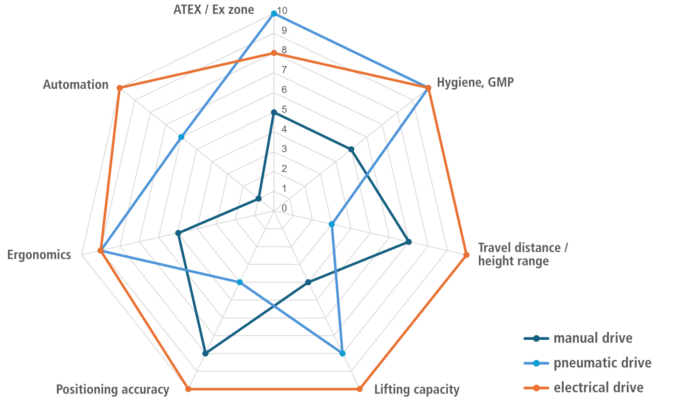
This network diagram illustrates the key differences between the three drive variants:
The drive elements of the lifting columns, which can be manual, electric or pneumatic, are housed inside the column. This results in a compact design.
With a pneumatic or electric drive, the control and operating elements can be installed separately from the lifting column — even in a different room, if necessary. However, for safety reasons, the operator must always have a clear view of the lifting column and its surroundings.
Swivel movement
In addition to vertical lifting, a lifting column can be fitted with swivel functionality.
With a stationary lifting column, the column itself can swivel around its vertical axis. This movement is performed manually. The lifting column locks into place at defined positions in the swivel circle, thus ensuring precise alignment. The locking mechanism can be released using a switch on the rotary handle.
An alternative to rotating the entire column is to fit a joint to the boom or fork connection on the column. This allows the boom to be manually swivelled in the horizontal plane. Such a joint is available for both mobile and stationary lifting columns.
Operation in hazardous areas (ATEX/explosion protection)
Lifting columns can be designed for use in production areas with a dust-explosive atmosphere. Many lifting columns are used in Zone 22, which is at risk of dust explosions.
Volkmann vacuum conveyors in the VS and PPC series have been type-examined for installation and operation in zones 1, 2, 21 and 22.
Use of lifting columns
Volkmann lifting columns / hoists are used in a variety of industrial sectors and conditions, including in the chemical and pharmaceutical industries, as well as in food production.
They are often used to position and connect vacuum conveyors to machines or containers. The list below shows typical applications:
- Containers or receptacles
- Mixers
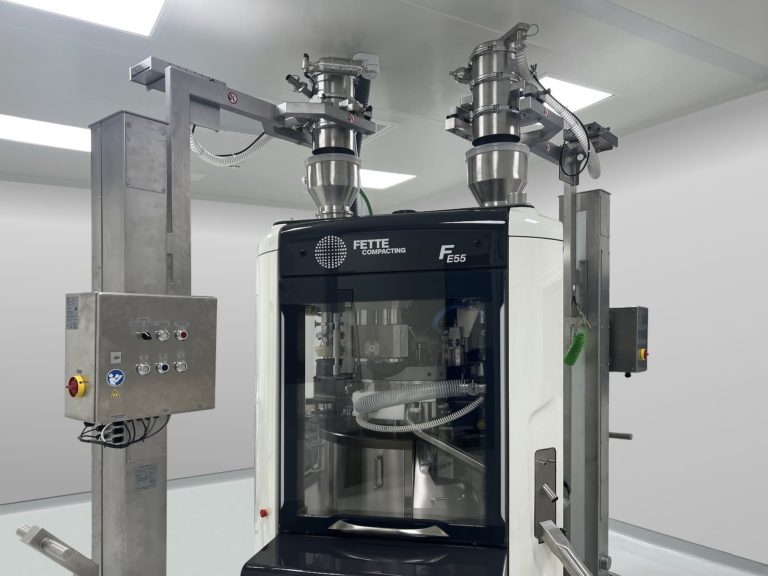
- Tablet presses
- Hard gelatine capsule filling machines
- Screening machines
- Packaging machines (e.g. for blister packs)
- Other processing machines
Lifting columns can be used to perform various tasks and achieve different objectives:
- Filling containers or bins of different sizes: the vertical position of the vacuum conveyor is adjusted to suit the height of the container.
- Ergonomic cleaning and maintenance of the vacuum conveyor: To fill machines such as a mixer or a packaging machine, the vacuum conveyor often has to be mounted in an elevated position. With a lifting column, the vacuum conveyor can be quickly lowered to a low position for cleaning or maintenance. This gives the operator very ergonomic access to the vacuum conveyor. A stationary lifting column must offer a swivel movement in addition to the lifting axis. A mobile lifting column must be moved away from the system to provide free space for lowering.
- Free access to a machine or system: When cleaning a machine or system (e.g. tablet press), the vacuum conveyor can be moved to ensure unobstructed access. If the vacuum conveyor needs to be moved so that personnel have better access to the machine, a lifting column is the ideal solution.
- Decoupling of weight and vibrations: Occasionally, it is necessary to install a vacuum conveyor on a machine or discharge point without transferring mechanical weight forces to the machine. Another reason may be to decouple both systems from vibrations. The solution is a lifting column that fully supports the weight of the vacuum conveyor, including the bulk material content. A closed connection between the vacuum conveyor and the machine can be established, for example, by means of an elastic compensator. Another design is to extend the vacuum conveyor outlet with a nozzle that is inserted into a sufficiently large opening in the machine.
- Flexible use of a vacuum conveyor at several locations: With a mobile lifting column, the vacuum conveyor can be used in different production areas or at different stations (e.g. at several mixers).
- Moving the vacuum conveyor into a washing area: To clean the vacuum conveyor, the mobile lifting column with the installed vacuum conveyor can be moved into the washing area.
Docking systems
In many applications, the connection between the vacuum conveyor and the downstream machine or container is made manually. However, docking systems can also be used for automatic docking and undocking. The VIAS docking valve from Volkmann is one such option.
Docking systems from other manufacturers can also be used. Some vacuum conveyors on lifting columns in the pharmaceutical industry, for example, are operated with special aseptic transfer valves.
Special solutions
We also develop lifting columns as bespoke solutions for our customers , as shown in this example:
Mobile lifting columns were equipped with a metal detector for a customer in the pharmaceutical industry. The customer uses this setup to check powder for metallic foreign objects prior to packaging. This solution is presented in the following video:
You are currently viewing a placeholder content from YouTube. To access the actual content, click the button below. Please note that doing so will share data with third-party providers.
More InformationLifting columns for low ceiling heights
Lifting columns and vacuum conveyors can be adapted for use in spaces with low ceiling heights. If there is minimal space between the machine and the ceiling, the height of the vacuum conveyor can be reduced by separating the filter segment and the vacuum pump from the conveyor’s separation chamber. Additionally, a second filter stage can be attached to the lifting column.
Quick-change bracket for the vacuum conveyor
Occasionally, it is necessary to attach and detach the vacuum conveyor quickly from the lifting column. For cleaning or maintenance purposes, the conveyor must be detached and reconnected later. Ideally, this should be done without the use of tools.
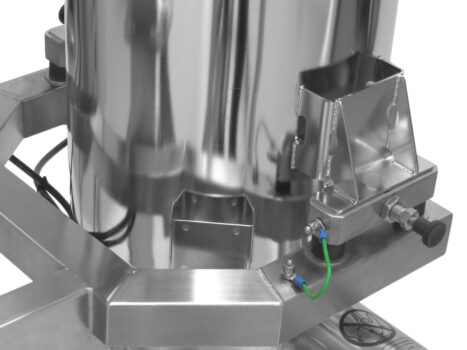
We offer an optional quick-change bracket for this purpose. To safely install and attach a Volkmann vacuum conveyor to the fork mount of the lifting column, simply insert it into the mounting block of the bracket with the corresponding guide pins and secure it in place with locking pins. The next step is to connect the conveyor line via a clamp connection, the pneumatic control hoses to the coupling sockets and the grounding cable.
Connections and media supply
The conveyor line, compressed air supply and electrical connections, along with any other lines, are routed from the lifting column via the boom to the vacuum conveyor. For mobile lifting columns, all pneumatic and electrical connections can be designed as plug-in connections. Customised connections can also be implemented.
Materials and surfaces
Our lifting columns are manufactured from AISI 304 stainless steel as standard. The surfaces are standard-finished by blasting (Ra <1.5 µm), but can also be ground to a finer finish (Ra <0.8 µm) on customer request.Automation
Lifting columns with electric and pneumatic drives are suitable for automated solutions. Optional interfaces allow data to be exchanged with other controllers or a higher-level master computer, for example as part of an OPC UA architecture.