Combined conveying and weighing: CONWEIGH
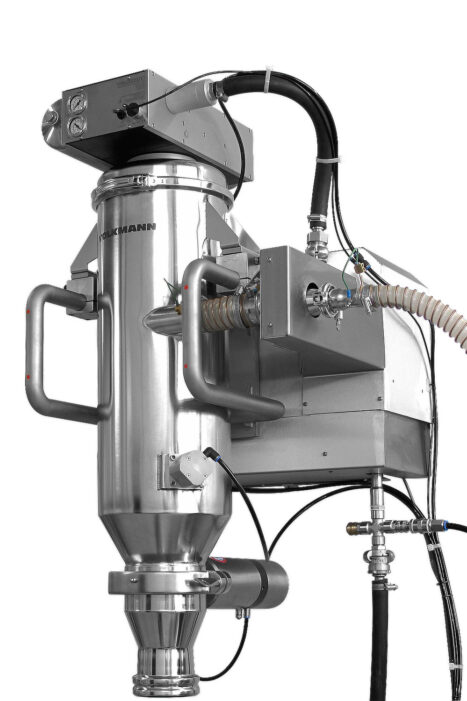
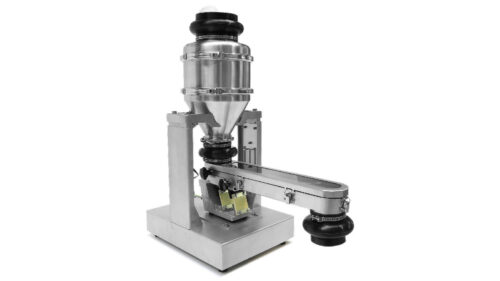
The CONWEIGH system adds a weighing function to a vacuum conveyor. The net weight of the product collected in the conveyor is measured continuously and the quantity conveyed can be adjusted to a set weight.
CONWEIGH technology adds a weighing function to a vacuum conveyor. One application is logging the quantity of product conveyed. CONWEIGH is primarily used for conveying, weighing and feeding a specified quantity of product.
Tried-and-tested vacuum conveyors from the VS and PPC series are used for transporting materials. The advantages of easy maintenance and cleaning are available to the user without restriction with the CONWEIGH system.
The CONWEIGH system allows the vacuum conveyor to be connected to multiple material feed points via product switches. This enables a recipe consisting of multiple components to be conveyed sequentially and automatically into a connected mixer, for example, with precise weight control.
CONWEIGH is one of several technologies that Volkmann offers for combining vacuum conveying with weighing. You can find an overview of all technologies here.
Conveying capacity and weighing accuracy
Typical dosing quantities start at 2 kg and can reach 100 kg or more. For larger target weights, the quantity is divided into several conveying cycles. The weight measurements from these cycles are then added together and, in the final cycle, the conveying is adjusted to reach the target value.
Depending on the design, the system can achieve an accuracy of between 99% and 99.7%. This accuracy is influenced by factors such as the material properties of the bulk material, the conveying capacity, and the target weight.
The maximum conveying capacity is 4,000 kg/h, depending on the size of the vacuum conveyor used.
Advantages of the CONWEIGH system
Combining conveying and weighing eliminates the need for separate handling operations.
From the moment the product enters the system until it is delivered to the next machine or container, the conveyed material remains in a closed system consisting of conveyor lines and a vacuum conveyor. Separating the product from the environment increases safety for both the operator and the environment, while also protecting the product from contamination.
How it works
The CONWEIGH system uses one or more load cells, depending on the size of the vacuum conveyor. The system control (PLC) receives approximately 20 measured values per second while material is being conveyed through the vacuum conveyor. The PLC then adjusts the conveying capacity of the vacuum conveyor based on these values.
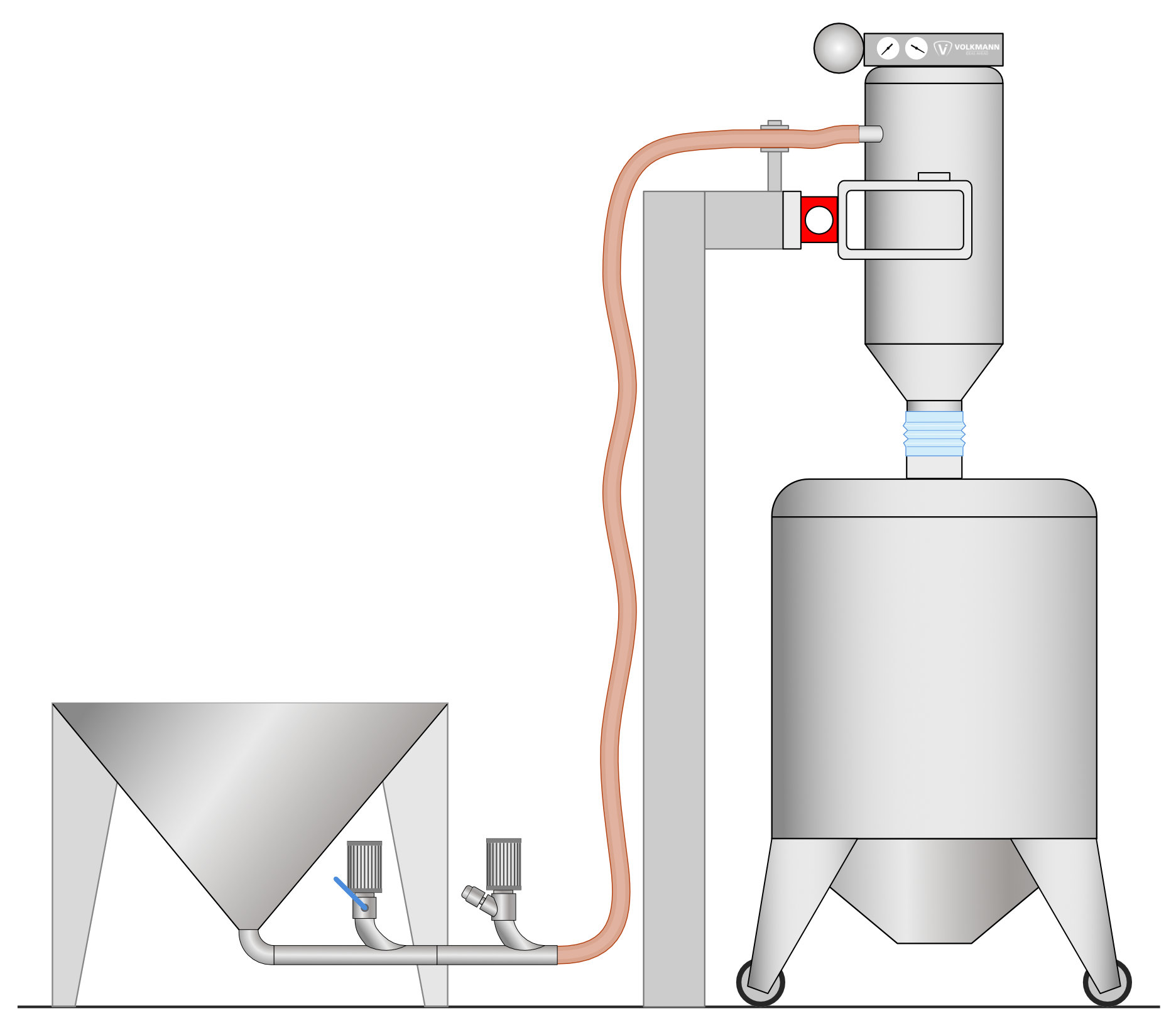
The vacuum conveyor is installed in a support frame that is connected solely by load cells to the rack. To ensure that the weight measurement is not influenced by the lines, all conveyor lines, supply lines and the connection to the downstream station (machine or container) are mechanically decoupled between the rack and the vacuum conveyor.
The system control adjusts the conveying capacity of the vacuum conveyor continuously and dynamically. This is achieved by opening or closing a thin-stream valve near the product feed point. The more air that flows into the conveying air via the valve, the lower the proportion of air from the product feed area and the less material is sucked in.
Vacuum conveyor
Support frame
Load cell
Compensator
Product feeding station (e.g. RNT 180)
Secondary air (false air)
Controlled thin-stream valve
Product discharge (e.g. into a container)
The system begins each conveying cycle with maximum capacity. Once the measured weight has approached the target quantity sufficiently, the conveying capacity gradually reduces until it stops when the target weight is reached.
Several conveyor cycles are required to reach the target value for large target weights or conveyor weights. In this case, all cycles except the final one are performed at full power. The weight conveyed is recorded each time and added up over the cycles. During the final conveyor cycle, the conveyor output is reduced towards the end to bring the quantity to the target weight.